Tuesday, 22 March 2016

Technophobia


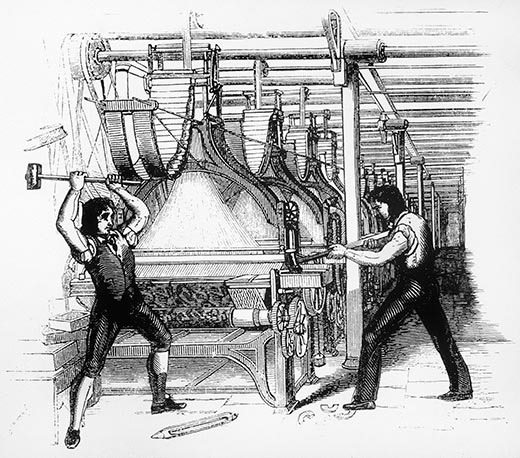
Until a few weeks ago I had not come across the term technophobia. I understood that people could be quite reluctant to use technology as it can seem to be complex and confusing. However I did not realise the extent of anxiety some people feel when using technology. Technophobia can be seen to go right back into the 18th century, when Ned Ludd smashed up 2 stocking frames. This is where the term Luddites stemmed from. Luddites in the modern day are people opposed to new technology, this is quite similar to people with technophobia, as they have no desire to use or try to understand how to use technology. Technophobia can be seen as a barrier within school's as teacher's may project their negative attitude or anxiety onto the children when using technology. 

Due to technology rapidly evolving, with new advanced technologies coming into schools there is an increase in computer anxiety and negative attitudes towards these technologies. In 1997 a BBC news report highlighted how there was an increase in the number of people who are victims of technophobia due to their lack of understanding and knowledge of the modern technologies (BBC, 1997). This technophobia has been around for decades, but can be seen as a huge barrier in schools when introducing a new technology into the classroom.

In the National Curriculum (2013) it highlights that ICT should be embedded throughout the curriculum therefore it is the teacher's duty to implement technology throughout most lessons. If teachers are technophobic, students will not have the exposure they need to the different, innovative technologies. This could have a detrimental effect on these student's as they need to be able to learn how to use technology effectively or they will not have sufficient knowledge and skills to use technology in the digital world. 

It is for the schools to provide correct training and support for these teachers. Brosnan (1998) indicates that without effective training and appropriate support the teachers will either avoid computers or "teach computers while passing anxiety, negative cognitions and negative attitudes to their students". This negative attitude and anxiety could influence the student's (Brosnon, 1998). Therefore with the correct guidance teacher's can start to change their attitudes on technology. As teacher's, they are tasked to inspire and provide opportunities for the children and therefore it is the schools duty to provide training and support to aid this.

REFERENCES:

BBC, (1997) "Is technology taking over the world?" Available at: http://news.bbc.co.uk/1/hi/special_report/for_christmas/_new_year/technophobia/41853.stm (Accessed: 18 March 2016).

Brosnan, M. (1998) Technophobia. London: Routledge.


Coniff, R. (2011) [image] Available at: https://strangebehaviors.wordpress.com/2011/02/24/the-luddite-revolution-birth-of-a-brand/

Department of Education (2013), Computing programmes of study: Key Stages 1 and 2.

Teacher's Attitudes towards ICT


Figure 1


Some teacher's lack the skills and knowledge to effectively use technology. Due to new, evolving technologies, teacher's may have a negative attitude towards using ICT in the classroom. Although most children are now digital natives, some teacher's may not be. They therefore do not have the confidence to teach using technology. With guidance, teacher's will be able to gain the technological knowledge and skills needed to integrate learning about technology into the learning environment.

Some teacher's can see new technology as too complex and therefore refuse to use it or learn the necessary skills to use it. In the widely disputed technology acceptance model (Davis, Bagozzi and Warshaw, 1989) it highlights that people perceive technology depending on the usefulness and ease of use. Therefore teacher's are unlikely to use technology in their classroom if they are too complex to learn and use. Koehlar and Mishra (2009) indicate that if teacher's do not have the combination of technological, pedagogical and content (TPACK) knowledge they will therefore not have the ability to effectively teach and integrate technology into the classroom.

As a student teacher I can see the importance of having a controlled and calm environment to teach. Teacher's need to be in control of their class at all times, as without this control the classroom would be very disruptive and inconducive to learning. When using technology in the classroom some teacher's see this as taking away their control as the children are then in charge of the technology. Rotter's (1954) locus of control highlights how people either have an internal or external locus of control. A person who has an internal locus of control may get frustrated by the technology due to their lack of control. Whereas a person who has an external locus of control would be more passive and accepting of these new technologies. The behaviour and personality of a teacher can determine whether they will accept new technologies within their classroom.


How do we change these negative attitudes?

We need to create a culture, which is more accepting of technology. This can be through training days for teacher’s so they can their develop basic ICT skills. These training days will build confidence, which will enrich their trust, safety and security in the use of ICT. Another way to increase positive attitudes towards ICT is by teacher’s who are confident to give guidance and support to those who are not.

Even though I have mentioned that negative attitudes can be linked towards the teacher's personality types, we need to ensure the teacher have the right support and guidance to be able to emit a positive attitude to their students. 

REFERENCES:

Davis, F., Bagozzi, R. and Warshaw, P. (1989) "User Acceptance of Computer Technology: A comparison of Two Theoretical Models", Management Science, 35(8), pp. 982-1003. doi: 10.1287/mnsc.35.8.982.

Koehlar and Mishra (2009). What is Technological Pedagogical Content Knowledge. Contemporary Issues in Technology and Teacher Eduation, [online] 9 (1), pp. 60-70. Available at: http://www.ctiejournal.org.articles/v9i1general1.pdf [Access 19 March 2016)]. 

Koehlar and Mishra (2009) [image] Available at: http://www.ctiejournal.org.articles/v9i1general1.pdf [Access 19 March 2016)]. 


Rotter, J. (1954) Social learning and clinical psychology. New York: Prentice-Hall.

Digital Literacies


Overview diagram of the Five Resources model; all text is duplicated on the 5 Resources Framework pages

Within the National Curriculum for Computing (2013), it indicates that student's are to be "active participants in a digital world", therefore teacher's are to prepare their pupil's to become digital literate.

Being a computing and ICT specialist, I need to be digital literate. Growing up with new, evolving technology I was able to discover for myself how to use these technologies and gain the knowledge and skills needed to become digital literate. As most children are digital natives they possess a certain amount of digital literacy (Ng, 2012). Before they step into a classroom they are most likely to have used mobiles, ipads and laptops (Ng, 2012). School's should ensure that these children develop and build on these digital literacy skills.

The Guardian (2012) coined digital literacy as, "digital tool knowledge + critical thinking + social engagement". By integrating technology through all aspects of the curriculum, such as using interactive whiteboards, iPads and laptops, the student's are exposed to a wide range of technology and the use of the internet. This exposure will build on their knowledge, skills and behaviour towards different technology and they will discover how to use the internet to create, share and utilize content. Not only teacher's should prepare the student's to become digital literate but the learning environment should also provide them opportunities to develop these skills (Meyers, Erickson and Small, 2013). These learning environments which could include a space where children can freely use different types of technology and a place to collaborate with other students, which will provide opportunities for the student's to acquire the knowledge and skills needed to become digital literate.This could be during class time or potentially as a club in the student's free time. 

However there are some barriers and constraints to becoming digital literate in schools. These include school's not having a wide range of digital access, resulting in the student's lacking particular skills needed in the digital world (Meyers, Erickson and Small, 2013). If this is the case, teacher's can still expose the student's to certain technologies and teach them basic skills on how to use the internet. Another barrier to becoming digital literate within school, is the teacher's lack of expertise and support to be able to effectively teach their students. It is therefore the Universities and school's duties to provide guidance and support for these teacher's to ensure they are confident in teaching ICT.

REFERENCES

Anyangwe, e. (2012) "20 ways of thinking about digital literacy in higher education" , The Guardian. Available at: http://www.theguardian.com/higher-education-network/blog/2012/may/15/digital-literacy-in-universities (Accessed: 18 March 2016).

Department of Education, (2013). Computing programmes of study: key stages 1 and 2.

Hinrichsen, J. and Coombs, A. [image] Available at: https://sites.google.com/site/dlframework/

Meyers, E., Erickson, I. and Small, R. (2013) "Digital literacy and informal learning environments: an introduction", Learning, Media and Technology, 38(4), pp. 355-367. doi: 10.1080/17439884.2013.783597.

Ng, W. (2012) "Can we teach digital natives digital literacy?", Computers and Education, 59(3), pp. 1065-1078. doi: 10.1016/j.compedu.2012.04.016


Memory and Recall


As teacher's we need to set up a learning environment where student's can remember and recall. We need to set up a starting point within the children's learning so children are able to begin the process of memory.

Atkinson and Shiffrin (1989) indicate through the Modal Model of Memory that there are 3 separate components to remembering. The first is the sensory, second the short term memory and the third long term memory. The sensory component, which holds information for the short term memory. The process starts through visually seeing something (iconic), or hearing something (echoic). For example, as soon as the child walks into the class and sees a visually exciting display board this can start their memory process. But without repetition this memory can decay and we therefore need to rehearse the information for it to move into the short term memory. George Miller (1956) stated that our short term memory can hold 7 things (plus or minus 2) at a time, "the magic number seven". With more rehearsal this memory can then move into the permanent, long term memory.

Baddley and Hitch (1974) introduced the Working Memory Model, which is an alternative to Atkinson and Shiffrin's Modal Model of Memory (1989). It highlights the process of remembering as a unitary system. Baddley and Hitch (1974) demonstrate short term memory as the working memory. The working memory has a greater focus on applying real life tasks such as, reading, problem solving, visual and spacial processing (McLeod, 2012). However, this particular model does not emphasise the importance of rehearsal, which I would argue is vital for remembering.

Tulving (1972) made the distinction between episodic and semantic memory. Episodic is the recalling of memories, whereas semantic is the store for more general knowledge. Semantic memory requires multiple exposures to the information rather than episodic only needing one exposure. For children to gain knowledge from school it is vital to rehearse and repeat as they need numerous exposures to retain information.

Teacher's can improve children's memory by relating to another topics and by the children physically learning something, for example using an interactive whiteboard children are more engaged with the physical interaction (Smith et al, 2005). As Piaget's theory (1952) of cognitive development indicates that children learn from experiences, teacher's are to create these experiences through sensory lessons for the children to remember and recall. 

All these models of memory have a starting point, which then progress into short term or working memory and then long term. Teacher's can start this memory process, by engaging the children with a visually exciting environment to capture and hold the children's attention. I would argue that repetition is key to remembering. Teacher's need to set up this environment, which is able to capture and hold the children's attention.

REFERENCES:

Atkinson, R. C., and Shiffrin, R. M. (1968). 'Human memory: A proposed system and its control processes' , in Spence, K. W., and Spence, J. T. The psychology of learning and motivation. New York: Academic Press, pp. 89-195.

Baddeley, A. D., and Hitch, G. (1974). 'Working memory' , in Bower, G. H. (Ed.), The psychology of learning and motivation: Advances in research and theory. New York: Academic Press, pp. 47-89.

McLeod, S. A. (2012). Working Memory. Retrieved from www.simplypsychology.org/working%20memory.html

Miller, G. (1956) "The magical number seven, plus or minus two: some limits on our capacity for processing information" , Psychological Review, 63(2), pp. 81-97. doi: 10.1037/h0043158. 


Piaget, J., and Cooke, M. T. (1952). The origins of intelligence in children. New York: International University Press.


Smith, H., Higgins, S., Wall, K. and Miller, J. (2005) “Interactive whiteboards: boon or bandwagon? A critical review of the literature”,Journal of Computer Assisted Learning, 21(2), pp. 91-101. Doi: 10.1111/j.1365-2729.2005.00117.x.

Tulving, E. (1972).
'Episodic and semantic memory' , in Tulving, E. and Donaldson, W. Organization of Memory. New York: Academic Press, pp. 381-403.


Effective Learning Environments


As you can see by this video, my focus is mainly on catering individual needs to create an effective learning environment. 


Loftus (1979) indicated that for student's to learn they are to be in a comfortable and calm environment. This can be created through a comfortable seating area or different types of learning areas such as, individual spaces and group work seating. To create a calm environment there has to be effective behaviour management in place to create a framework for the children on how to behave. The teacher should create an environment which has positive reinforcement and where the children are encouraged to achieve the best of their ability. 

Due to technology becoming more advanced it is becoming easier to create a learning environment that caters to each child's individual needs. This would include using iPads for individual or pair work and using interactive whiteboards for whole class lessons. Smith et al (2005) highlight that if there is interactivity such as using interactive whiteboards there will be more student engagement. Children like the physical interaction with the board, which could mean they are more motivated in answering questions correctly (Smith et al, 2005).


A learning space should be where all children with different learning styles thrive.

REFERENCES:

Atkinson, R. C. and Shiffrin, K. M. (1968) 'Human memory: A proposed system and its control processes,' in Spence, K. W. and Spence, J. T. The Psychology of learning and motivation. New York: Academic Press. pp. 85-195.

Oxforddictionaries.com (2016) Oxford University Press. [online] Available at: http://www.oxforddictionaries.com/ [Accessed 16 Feb 2015].

Piaget, J. (1958). The growth of logical thinking from childhood to adolescence. AMC. 10. 12

Smith, H., Higgins, S., Wall, K. and Miller, J. (2005) "Interactive whiteboards: boon or bandwagon? A critical review of the literature", Journal of Computer Assisted Learning, 21(2), pp. 91-101. doi: 10.1111/j.1365-2729.2005.00117.x.

Vygotsky, L. S. (1978) Mind in Society: The development of higher psychological processes. Cambridge, MA: Harvard University Press.


Saturday, 20 February 2016

What is Learning?

As a 2nd year student teacher when asked, "what is learning?" should be an easy question to answer. But when I was asked a few weeks ago I struggled for an answer. I concluded with "finding out about new things and gaining knowledge." But learning is much more than that. Within the Oxford Dictionary (Oxforddictionaries.com, 2016) it states that learning is "the acquisition of knowledge or skills through study, experience, or being taught."

Learning is a process. It is a process that involves repetition and practice. From the day we are born we learn how to walk and talk, we learn how to solve problems and master a range of skills. Bloom's Taxonomy (Atherton, 2013) highlights learning as a process through three domains of learning. Within the cognitive domain Bloom created a taxonomy, which indicated that from knowledge we can progress through higher order thinking to be able to evaluate and synthesise (Atherton, 2013). 

Learning is complex. Children learn in all different ways and it is for teacher's to understand how they learn, and help them progress accordingly. To understand the three main learning theories, behaviourism, cognitivism and constructivism we can understand how learning is formed and created. With theorists such as Bruner, Vygotsky and Piaget we can understand the different types of learning and how we learn from each other. 

Learning is primarily all about engagement and excitement. Teachers need to engage and inspire children for effective learning. With the help of technology there is a new element to learning, which the teacher can use to develop lessons to engage and inspire the student's to understand and learn better. 

References:

Atherton J S (2013) Learning and Teaching; Bloom's taxonomy. [online ] Available at:  http://learningandteaching.info/learning/bloomtax.htm [Accessed 16 Feb 2016].

Oxforddictionaries.com (2016) Oxford University Press. [online] Available at: http://www.oxforddictionaries.com/ [Accessed 16 Feb 2016].